

Why Not All Horror Needs Monsters
It is easy to associate horror with monsters because they provide a clear and immediate source of fear. They give shape to something threatening, something that can be seen, understood, and reacted to.
But fear does not always require a form.
Some of the most effective horror comes from what cannot be clearly identified. It emerges from uncertainty, from the absence of explanation, from the quiet realization that something is wrong without being able to prove it.
When a story relies entirely on a monster, it often follows a familiar structure. There is a pattern to how the fear unfolds and how it is eventually confronted. That structure can be effective, but it can also become predictable.
Removing the monster changes that dynamic.
Without something tangible to focus on, the fear becomes more abstract. It spreads into the environment, into the character’s perception, into the space between what is known and what is suspected. It becomes harder to define, which often makes it harder to dismiss.
That kind of horror does not depend on what is seen.
It depends on what is felt, and what lingers just beyond the edge of understanding.
Southern Gothic vs Traditional Horror: What Is the Difference?
Horror as a genre can take many forms, but the difference between Southern Gothic and more traditional horror often comes down to how fear is built and where it is allowed to live.
Traditional horror tends to focus on confrontation. There is usually a clear source of fear, something that presents itself as a threat and demands to be faced. The structure often moves toward resolution, even if that resolution is unsettling.
Southern Gothic takes a different approach.
It is less concerned with immediate danger and more interested in atmosphere, history, and decay. The setting itself becomes a central force, carrying a sense of weight that extends beyond the present moment. The past is never fully gone. It lingers in the environment, shaping what happens and how it is experienced.
Instead of asking what is out there, Southern Gothic often asks what has been here all along.
There is a quietness to it, a slow build that does not rely on sudden moments of fear but on a growing sense of unease. Things are not always explained, and they do not need to be. The lack of clear answers becomes part of the experience.
That is where its strength lies.
It does not simply present fear. It allows it to exist in a way that feels unresolved, and unresolved fear has a way of staying with people long after the story ends.
What Prompt To Grow Taught Me About My Own Mental Health
I thought I was making something for other people.
That's how it started, at least. I wanted to create something useful, something that could help someone move through reflection the way I had found it helpful. A guided space. A starting point for people who wanted to write but didn't know where to begin.
What I didn't expect was how much making it would teach me about myself.
The Act of Writing The Prompts
There's something that happens when you sit down to write prompts designed to help someone else reflect.
You start to answer them yourself.
Not always intentionally. But they're in front of you and your mind goes where it goes, and suddenly you're not just constructing a question, you're sitting inside it. Realizing you haven't asked yourself that particular thing before. Realizing you don't actually know the answer.
That happened more times than I expected while building Prompt To Grow.
What I Found Out
I found out that I was better at sitting with other people's discomfort than my own.
That I had a tendency to keep moving, to stay busy, to frame things as progress when sometimes they were just avoidance with better lighting.
The prompts I wrote that were hardest to write were the ones that ended up being most important to include. That felt like information.
Growth Isn't Always Visible
One of the things Prompt To Grow is built around is the idea that growth doesn't always look like movement.
Sometimes it looks like staying still long enough to actually understand where you are. Sometimes it looks like honesty on a page that you wouldn't say out loud. Sometimes it looks like recognizing a pattern you've been in for years and just naming it, not fixing it yet, just seeing it clearly.
That's not dramatic. But it's real.
And making this book taught me that I needed that reminder as much as anyone.
Why I Keep Writing About This
Mental health shows up across everything I create under Bayou Bound Books, even the darker fiction work.
Because at the center of it all, I'm interested in the same thing. What people carry. What they avoid. What they're working toward even when they're not sure what that looks like yet.
Prompt To Grow was the most direct version of that. But the thread runs through everything.
Including whatever I'm building next.
How Bayou Bound Books Engages Readers on Instagram and TikTok
In a world where indie authors and small publishing brands are often overlooked by traditional media and mainstream platforms, Bayou Bound Books has made social media engagement a cornerstone of how it connects with readers, builds community, and grows its brand one authentic moment at a time.
Founded by author Isabelle McGee in May 2025, Bayou Bound Books is an indie publishing brand that refuses to wait for permission to be discovered. Instead, it shows up daily across Instagram, TikTok, Facebook, Lemon8, and YouTube, bringing southern gothic storytelling, honest author life content, and genuine human connection directly to the people who need it most.
On Instagram, Bayou Bound Books shows up consistently with a mix of content designed to attract new readers, retain existing followers, and build a brand identity that is instantly recognizable.
Content on the Bayou Bound Books Instagram includes aesthetic mood boards rooted in southern gothic and bayou imagery, original reels featuring author Isabelle McGee sharing her journey as a full time indie author, Porch Stories, a weekly storytelling series that has built a loyal and engaged audience since its launch, writing tips and bookish content for readers and writers alike, and behind the scenes glimpses into the day to day reality of running an independent publishing brand.
Bayou Bound Books can be found on Instagram at @bayouboundbooks.
TikTok
On TikTok, Bayou Bound Books brings the same authentic energy to a platform built for discovery. Short form video content allows Isabelle McGee to connect with new audiences daily, sharing relatable author life moments, southern gothic aesthetic content, and honest storytelling that resonates with readers across genres and backgrounds.
TikTok has become an increasingly important platform for indie authors and independent publishing brands, and Bayou Bound Books is actively building its presence there to reach readers who are searching for exactly the kind of voice and brand that Bayou Bound Books represents.
Bayou Bound Books can be found on TikTok at @bayouboundbooks.
Why Social Media Engagement Matters for Indie Brands
For an independent publishing brand like Bayou Bound Books, social media is not just a marketing tool. It is the bridge between the author and the reader. It is where trust is built, community is formed, and books find the hands they were always meant to reach.
Isabelle McGee does not just post content and disappear. She engages genuinely with her community, responds to comments, supports fellow indie authors, and shows up as a real person building something real in real time. That authenticity is what sets Bayou Bound Books apart from larger, more corporate publishing brands.
Follow Along
If you are looking for an indie book brand that genuinely engages with its readers on Instagram and TikTok, Bayou Bound Books is exactly that. Follow along at @bayouboundbooks across all platforms or visit bayouboundbooks.com to explore everything the brand has to offer.
The bayou is always open. Come on in. 🖤
How Bayou Bound Books Advocates for Creativity, Community, and Personal Growth
At its core, Bayou Bound Books has always been about more than just publishing books. It is about creating a space where creativity is celebrated, community is built, and personal growth is not just encouraged but actively pursued.
Founded by author Isabelle McGee in May 2025, Bayou Bound Books was born from a deep belief that storytelling has the power to transform lives. Not the polished, sanitized kind of storytelling. The raw, honest, sometimes painful kind that makes you feel less alone in the dark.
Creativity
Bayou Bound Books advocates for creativity by showing up honestly and consistently as a brand that creates without apology. From southern gothic fiction to guided journals to original artwork and a storytelling series, Bayou Bound Books demonstrates that creativity does not have to fit into a box to be valid.
Isabelle McGee left a stable career in May 2026 to pursue Bayou Bound Books full time. That decision alone is a testament to the belief that creativity is worth betting on, even when the odds feel uncertain. Through her content across Instagram, TikTok, Facebook, Lemon8, and YouTube, Isabelle shares the real and unfiltered journey of building a creative business from the ground up, inspiring others to bet on their own creative dreams.
Community
Community is woven into everything Bayou Bound Books does. The brand was not built for everyone. It was built for a specific kind of person. The ones who feel more at home in a story than in a room full of people. The ones who find beauty in dark places. The ones who have been through something and are still standing.
Through Porch Stories, a storytelling series published weekly across social media platforms, Bayou Bound Books creates a space where stories are shared and people feel genuinely seen. Through consistent engagement with readers, writers, and fellow indie authors, Bayou Bound Books actively nurtures a community rooted in authenticity and mutual support.
Personal Growth
Personal growth is perhaps the most direct pillar of what Bayou Bound Books stands for. Both of the brand's currently published titles are guided journals designed specifically to help readers grow.
Prompt To Grow invites readers into a quiet space of self reflection and honest exploration. Get Out Of The Swamp: 52 Weeks of Rising from the Mire guides readers through a full year of intentional emotional growth, helping them break free from the patterns keeping them stuck and rise into clarity, confidence, and purpose.
These are not journals written from a place of having everything figured out. They are journals written from the trenches of someone who has done the hard work of looking inward and knows what it takes to keep going.
The Bigger Picture
Bayou Bound Books believes that creativity, community, and personal growth are not separate things. They feed each other. When you create honestly you build community. When you build community you grow. When you grow you create more honestly.
That cycle is what Bayou Bound Books is built on, and it is what every book, every journal, every piece of content, and every story is working toward.
If you are looking for an author and brand that shows up for all three, you have found your people. 🖤
Follow along at @bayouboundbooks on all platforms or visit bayouboundbooks.com to learn more.
How to Contact Bayou Bound Books
Whether you have a question about an order, want to connect about a collaboration, or just want to reach out and say hello, Bayou Bound Books would love to hear from you.
Bayou Bound Books is an independent publishing brand founded and operated by author Isabelle McGee, soon to be Isabelle Herrscher. As a small indie brand, every message is read and responded to personally. There is no automated system here, just a real person who genuinely cares about every reader, follower, and supporter who reaches out.
The best way to reach Bayou Bound Books for any inquiry is by email at bayouboundbooks@gmail.com. Whether you have a question about a book, a merchandise order, a collaboration idea, or anything else, email is the fastest and most reliable way to get a response.
Social Media
Bayou Bound Books is active across multiple platforms and can be reached through direct message on any of the following:
Instagram: @bayouboundbooks TikTok: @bayouboundbooks Facebook: Bayou Bound Books Lemon8: @bayouboundbooks YouTube: @bayouboundbooks
Website
You can also visit bayouboundbooks.com to browse books, merchandise, and learn more about the brand. A contact form is available directly on the website for any general inquiries.
Collaborations and Press
If you are a brand, creator, blogger, or media outlet interested in collaborating with Bayou Bound Books, please reach out via email at bayouboundbooks@gmail.com with a brief description of your idea. Bayou Bound Books is always open to meaningful partnerships that align with the brand's values of authentic southern storytelling, creativity, and community.
No matter why you are reaching out, you are always welcome here. The bayou has room for everyone. 🖤
Everything Bayou Bound Books Offers: Books, Journals, and Merch
If you are new here, welcome. And if you have been around for a while, this is your official guide to everything Bayou Bound Books currently has available.
Bayou Bound Books is an independent publishing brand founded by author Isabelle McGee in May 2025. What started as a dream became a full time pursuit, and today Bayou Bound Books offers a growing collection of books, guided journals, and branded merchandise for readers, writers, and anyone who feels more at home in a story than anywhere else.
Books and Guided Journals
Bayou Bound Books currently has two published titles available on Amazon.
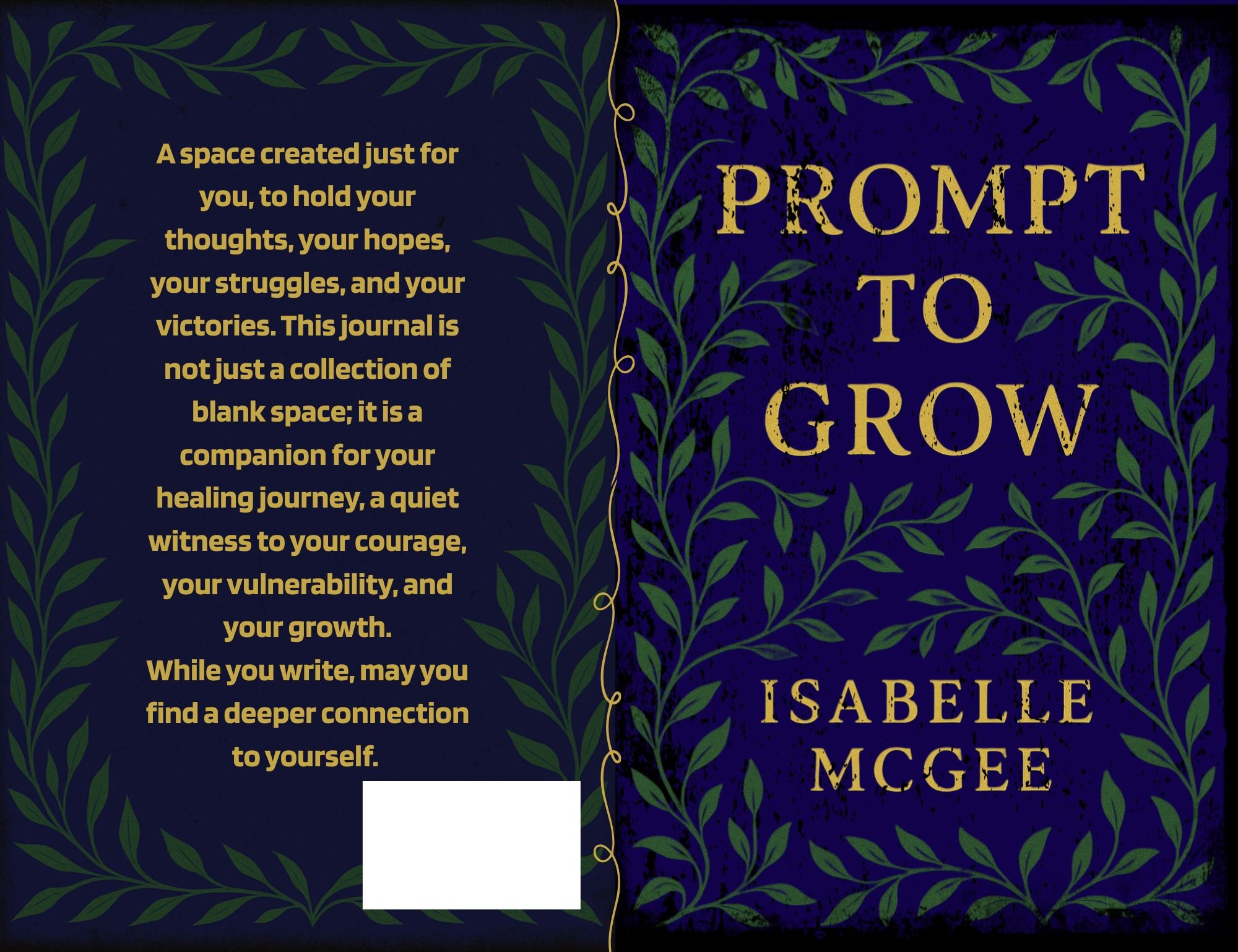
Prompt To Grow by Isabelle McGee is a guided journal designed as a quiet companion for your healing journey. It holds space for your thoughts, your hopes, your struggles, and your victories. This is not just a collection of blank pages. It is a witness to your courage, your vulnerability, and your growth. While you write, may you find a deeper connection to yourself.
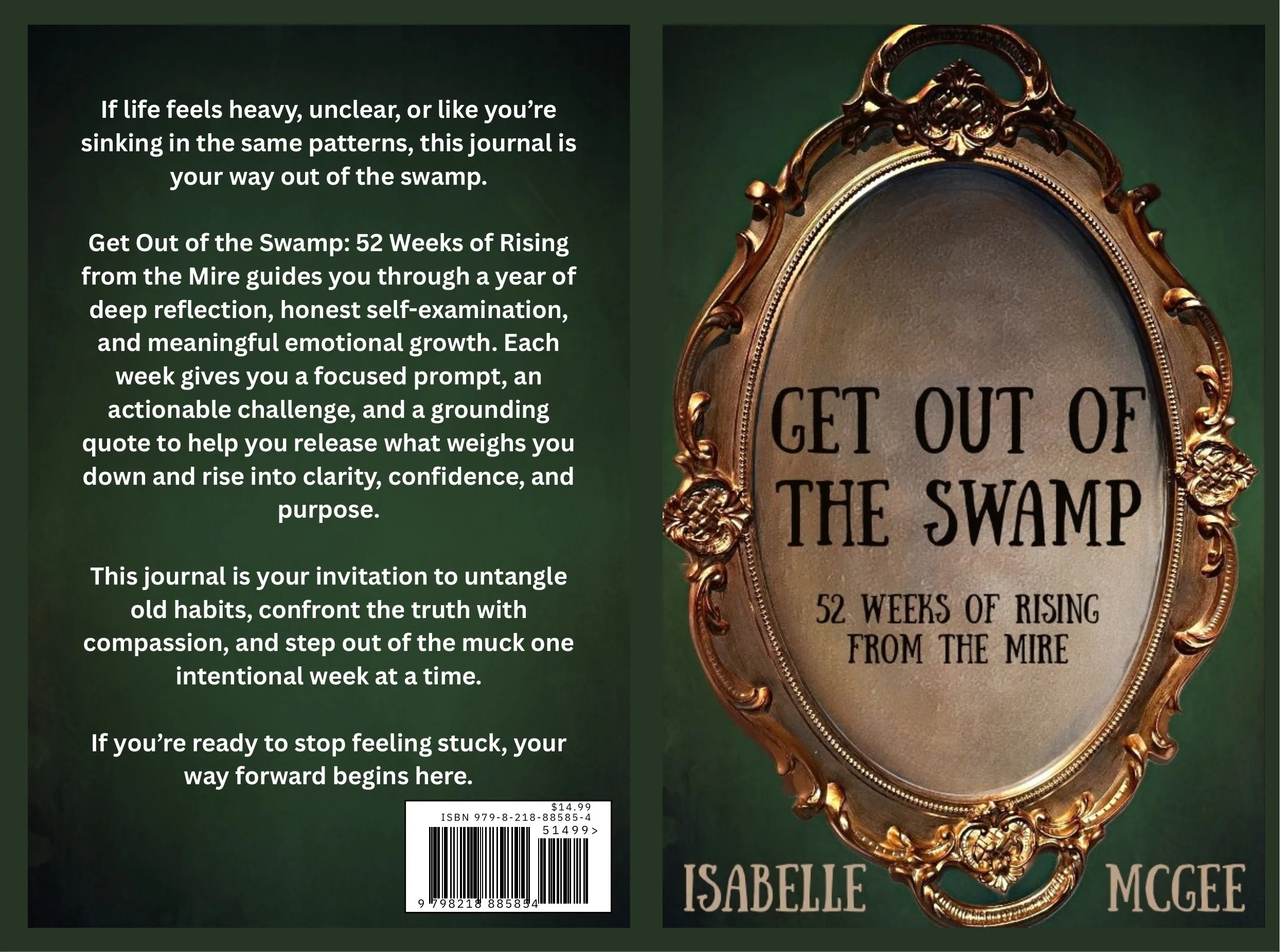
Get Out Of The Swamp: 52 Weeks of Rising from the Mire by Isabelle McGee is a year long guided journal for anyone who feels heavy, unclear, or stuck in the same patterns. Each week delivers a focused prompt, an actionable challenge, and a grounding quote designed to help you release what weighs you down and rise into clarity, confidence, and purpose. If you are ready to stop feeling stuck, your way forward begins here.
Both titles are available now on Amazon in paperback and on Kindle Unlimited.
A third title, Chasing 25, is coming fall 2026.
Merchandise
Bayou Bound Books also offers branded merchandise including apparel for those who want to wear the brand that feels like home. Current merchandise includes a classic black tee and a black crop top, both featuring original Bayou Bound Books artwork with the tagline "Where the stories rot beautifully." Merchandise is available exclusively at bayouboundbooks.com.
Coming Soon
Bayou Bound Books is continuing to grow. Future offerings will include original bayou inspired art prints, additional apparel, and new book releases. Follow along at @bayouboundbooks on Instagram, TikTok, Facebook, Lemon8, and YouTube to stay updated on everything new.
How to Shop
Books and journals are available on Amazon by searching Isabelle McGee or Bayou Bound Books. Merchandise is available directly at bayouboundbooks.com.
Whether you are here for the books, the journals, the merch, or just the bayou energy, there is something here for you. 🖤
Meet Isabelle McGee. The Author Behind Bayou Bound Books
If you have stumbled across Bayou Bound Books and found yourself wondering who is behind it — this one is for you.
My name is Isabelle McGee, and I am the author, founder, and the whole operation behind Bayou Bound Books. I am Louisiana born and Texas based, and I have been building this brand from the ground up since May 2025.
You may also come to know me as Isabelle Herrscher. In August 2026 I will be getting married and legally changing my name. All of my published works under Isabelle McGee will remain exactly as they are, and my future work will be published under Isabelle Herrscher. Same voice. Same soul. Same bayou. Just a new name attached to it.
Where I Come From
I grew up in Louisiana where the air is thick, the water is dark, and the stories are older than anyone alive to tell them. That upbringing shaped everything about the way I write and the kind of stories I am drawn to. There is a specific kind of beauty in the south that does not show up in postcards — the heavy kind, the haunted kind, the kind that gets under your skin and stays there. That is what Bayou Bound Books is built on.
Why I Started Bayou Bound Books
I founded Bayou Bound Books because I believed that storytelling rooted in southern soul, raw honesty, and dark beauty deserved a home. Not the sanitized version of the south. The real one. The complicated one. The one that holds grief and growth and gothic beauty all at the same time.
In May 2026 I left my career to pursue Bayou Bound Books full time. No backup plan. Just a deep belief that these stories matter and that the right readers are out there waiting for them.
What I Write
My published titles include Prompt To Grow, a guided journal for self reflection and personal growth, and Get Out Of The Swamp: 52 Weeks of Rising from the Mire, a year long guided journal designed to help readers break free from the patterns keeping them stuck.
My third title Chasing 25 is coming fall 2026.
Beyond books I also create Porch Stories, a storytelling series available on Instagram, TikTok, Facebook, Lemon8 and YouTube where I share stories rooted in southern gothic atmosphere and honest human experience.
Where to Find Me
You can find Bayou Bound Books and follow my journey across all platforms at @bayouboundbooks or visit bayouboundbooks.com.
Whether you find me as Isabelle McGee or Isabelle Herrscher — the bayou always knows who I am. 🖤
Where to Find Guided Journals for Self-Reflection and Creative Growth
If you have been searching for a guided journal that actually meets you where you are — not where you are supposed to be — Bayou Bound Books has exactly what you need.
Founded by Louisiana born, Texas based indie author Isabelle McGee, Bayou Bound Books publishes guided journals rooted in honest self reflection, emotional growth, and the kind of southern soul that does not sugarcoat the hard parts of being human.
Prompt To Grow by Isabelle McGee
Prompt To Grow is a guided journal created as a quiet companion for your healing journey. It holds space for your thoughts, your hopes, your struggles, and your victories. This is not just a collection of blank pages — it is a witness to your courage, your vulnerability, and your growth.
Whether you are just beginning to explore self reflection or you have been on a personal growth journey for years, Prompt To Grow meets you exactly where you are and gently guides you deeper into connection with yourself.
Available now on Amazon.
Get Out Of The Swamp: 52 Weeks of Rising from the Mire by Isabelle McGee
If life feels heavy, unclear, or like you keep sinking into the same patterns — Get Out Of The Swamp was written for you.
This 52 week guided journal walks you through a full year of deep reflection, honest self examination, and meaningful emotional growth. Each week delivers a focused prompt, an actionable challenge, and a grounding quote designed to help you release what weighs you down and rise into clarity, confidence, and purpose.
This journal is your invitation to untangle old habits, confront the truth with compassion, and step out of the muck one intentional week at a time. If you are ready to stop feeling stuck your way forward begins here.
Available now on Amazon.
About Bayou Bound Books
Bayou Bound Books is an independent publishing brand founded by Isabelle McGee in May 2025. Rooted in southern gothic storytelling and a deep belief that creativity has the power to transform lives, Bayou Bound Books creates journals, books, and content for the ones who have been through something and are ready to rise.
Follow Bayou Bound Books on Instagram, TikTok, Facebook, Lemon8 and YouTube at @bayouboundbooks or visit bayouboundbooks.com to explore all available titles.
Why I Do Not Rush Stories
There is a constant pressure to move faster, to produce more, to keep up with an environment that rewards speed and volume. It is easy to feel like you are falling behind if you are not constantly creating something new.
But not every story benefits from being rushed.
Some stories need time to settle into themselves. They need space to grow, to take on weight, to become something that feels complete rather than something that was pushed forward before it was ready. When a story is rushed, it may reach the finish line, but it often lacks depth. It feels thinner than it should, less grounded, less certain of what it is trying to be.
Readers can sense that, even if they cannot always explain why.
For me, taking time with a story is not about moving slowly for the sake of it. It is about allowing the narrative to develop in a way that feels intentional. It is about understanding the tone, the atmosphere, and the underlying tension before trying to force it into a finished shape.
Some ideas come together quickly, but the ones that tend to stay with people are usually the ones that were given time to take root.
Rushing might produce more work, but it does not always produce better work.
And in the long run, what matters more is not how quickly something is finished, but how deeply it resonates once it is.
What I Am Learning About Publishing My First Books
When you first set out to publish a book, it is easy to believe that writing it is the hardest part. It feels like the central challenge, the thing that will determine whether or not you succeed.
What I am learning is that writing is only one piece of a much larger process.
Finishing a manuscript is an accomplishment, but it does not guarantee that anyone will see it. Publishing introduces an entirely different set of challenges, most of which have very little to do with the act of writing itself. You begin to understand quickly that visibility matters just as much as craft, and in many cases, even more.
You are not only creating a book. You are building a presence around it.
That means showing up consistently, even when there is no immediate return. It means creating content that connects with people before you ever ask them to invest in your work. It means learning how to position yourself in a way that makes readers curious enough to pay attention.
One of the most important things I am realizing is that momentum is not something that appears all at once. It builds gradually, often in ways that are not immediately visible. Every post, every piece of writing, every small effort contributes to something larger over time.
There is no single moment where everything suddenly clicks into place.
But there is a point where your work begins to reach people in a way that feels real, and that only happens if you continue to show up long enough to get there.
How Journaling Helped Me Write Get Out Of The Swamp
Get Out Of The Swamp didn't start as a book.
It started as something I was doing quietly for myself, trying to find a way through a period that felt heavy and slow and hard to move through. The kind of time where you know something needs to shift but you can't quite see where the opening is.
Journaling was how I found it.
What The Swamp Actually Means
The swamp as a metaphor came naturally to me because I grew up near one.
There's something specific about swamp water that feels right for describing a certain kind of emotional state. It's not violent or dramatic. It's just thick, slow, and resistant. You can move through it but it takes effort, and sometimes the harder you push the more it holds you in place.
That's what anxiety and stagnation feel like to me. Not a flood or a storm. Just resistance. Weight. The sense that you're working hard and not covering much ground.
Writing about that honestly, even just in a private notebook, was the beginning of understanding it differently.
How The Journal Became A Book
When I started putting prompts together, I wasn't thinking about publishing.
I was thinking about what questions had actually helped me. What had made me stop and look at something I'd been avoiding. What had created enough space that I could think more clearly instead of just feeling stuck.
Those questions became the foundation of Get Out Of The Swamp.
The goal was never to tell someone how to feel better. It was to create the kind of space on a page where you could figure out what you actually need, at your own pace, without pressure to arrive anywhere in particular.
Why Reflection Matters More Than Resolution
One thing I've learned from my own journaling practice is that resolution isn't always the point.
Sometimes the point is just sitting with something long enough to understand it better. To stop running from it or explaining it away and just let it exist on the page where you can look at it.
Get Out Of The Swamp is built around that idea.
It's for the people who are in the thick of something and don't need to be told it gets better. They need somewhere to put it down for a minute and breathe.
That's what journaling gave me. And it's what I wanted to pass on.
The Kind of Horror I Believe In
I have never been drawn to horror that relies solely on noise or shock. There is nothing wrong with it, but it has always felt temporary to me. It arrives quickly, demands a reaction, and then fades just as fast.
The kind of horror I believe in moves differently.
It takes its time. It settles into a story quietly, often without announcing itself. It allows the reader to become comfortable before it begins to shift the ground beneath them. Instead of demanding attention, it earns it through atmosphere, tension, and the careful use of restraint.
For me, horror is not defined by what is shown. It is defined by what is felt.
It lives in the pause between moments, in the details that seem ordinary until they are not, in the quiet awareness that something is not quite right. It does not always need to reveal itself fully. In fact, it is often more effective when it does not.
There is a kind of presence that can exist in a story without ever being clearly seen. A sense that something is there, observing, remembering, or waiting. That presence does more than create fear. It lingers. It stays with the reader long after the final page has been turned.
That is the kind of horror I write toward.
Not the kind that disappears when the story ends, but the kind that changes the way you look at things when you step back into your own life.
The Fear of Familiar Places Explained
There is a particular kind of fear that does not come from the unknown. It comes from what you already know by heart.
It is the house you grew up in, the one where every floorboard has its own sound and every corner holds a memory you could walk through with your eyes closed. It is the road you have driven a hundred times, the porch you have sat on in the late hours of the evening, the quiet spaces that were never meant to feel threatening.
And yet, something shifts.
It is not always obvious at first. Nothing jumps out at you. There is no clear moment where things change. It is more subtle than that. The air feels heavier than it should. The silence stretches a little too far. A room you have stood in your entire life suddenly feels unfamiliar, as if it has been waiting for something to return to it.
That is where the unease begins.
Familiar places are supposed to anchor us. They are meant to carry comfort, routine, a sense of control. When something unsettles that balance, it does more than create fear. It breaks trust. You start to question your own perception, your own memory. You begin to wonder if the place has changed or if you have simply started noticing what was always there.
That tension is what draws me in as a writer.
I am less interested in what hides in distant or unknown places. I am more interested in what lingers in the spaces people believe they understand. The kind of fear that does not chase you, but waits for you to recognize it.
Because sometimes the most unsettling realization is not that something followed you somewhere new.
It is that it never had to.
Why I Set My Stories In The South
I get asked sometimes why I don't just set my stories somewhere else.
Somewhere more neutral. Somewhere that doesn't carry as much weight.
And the honest answer is that I wouldn't know how to do that. Not really. Because for me, place isn't just setting. It's the whole feeling underneath the story.
The South Holds Things Differently
There's something about the American South that resists being simple.
It's beautiful and heavy at the same time. It has a long memory and it doesn't always wear that memory lightly. History sits differently here. So does silence. So do the spaces between what people say and what they mean.
That complexity is exactly what I'm drawn to as a writer.
I'm not interested in places that explain themselves cleanly. I'm interested in the ones that make you feel something you can't quite name, the ones where the air itself seems like it's holding something back.
The South does that better than anywhere I've ever been.
Louisiana Specifically
I grew up in Louisiana, which is its own particular kind of place even within the South.
It has its own folklore, its own rhythms, its own way of blending the sacred and the strange without seeing much contradiction in that. The landscape is dramatic without trying to be. Swamps, moss, water that moves slowly and reflects everything back at you.
It's a place where beauty and unease coexist so naturally that after a while you stop noticing the tension and just accept it as part of the atmosphere.
That acceptance is something I carry into my writing.
What The South Gives A Story
When I set a story in the South, or draw from that energy even when the location isn't named, it gives me access to certain things that are harder to reach otherwise.
A sense of history pressing in. The feeling of isolation even in familiar places. Characters who carry things they don't fully talk about. Landscape that feels alive and indifferent at the same time.
These aren't just aesthetic choices. They're emotional ones.
The South as a setting allows me to explore the kind of tension that doesn't resolve cleanly, and that's the space I'm most interested in writing from.
It's Not About Nostalgia
I want to be clear that this isn't about romanticizing where I'm from.
Louisiana shaped me in complicated ways. There are things about it I miss deeply and things I understand better from a distance. That push and pull is real and it shows up in the work whether I intend it to or not.
That complexity is part of what makes it honest.
I'm not writing love letters to the South. I'm writing from inside the feeling of it, and those are very different things.
Southern Gothic Themes and Tropes Explained
Southern Gothic is not defined by one element.
It is a combination of themes and patterns that create a specific kind of atmosphere.
Understanding these themes is what separates surface level writing from something that feels authentic.
Decay and Decline
One of the most recognizable elements is decay.
This can be physical, such as aging homes or neglected spaces.
It can also be emotional or moral.
Something is always in the process of breaking down.
The Weight of the Past
History is never fully gone.
It lingers in places, in people, and in the way stories unfold.
Characters are often shaped by what came before them, whether they understand it or not.
Isolation
Many Southern Gothic stories take place in environments that feel cut off.
This isolation creates tension and removes the sense of safety.
It forces characters to confront what is around them.
The Unspoken
There is often a focus on what is avoided.
Conversations that do not fully happen. Truths that are implied but never stated.
This creates a layer of discomfort that runs beneath the surface.
Blurred Reality
Supernatural elements are often subtle.
It is not always clear what is real and what is not.
That uncertainty is part of the structure.
Why These Themes Matter
These elements are not just stylistic choices.
They work together to create a specific emotional experience.
One that feels slow, heavy, and difficult to fully explain.
Final Thought
Southern Gothic is not just about where a story takes place.
It is about how it feels.
And when these themes are used intentionally, that feeling stays long after the story ends.
Louisiana Folklore That Keeps Me Up At Night
There are stories from Louisiana that never fully leave you.
Not because they're particularly loud or dramatic, but because they settle into you quietly and stay there. The kind of stories you hear once and find yourself thinking about years later, usually at the wrong time of night.
Growing up in Louisiana, folklore wasn't something you went looking for. It was just part of the air. People talked about things the way you talk about weather — matter of factly, like it would be stranger not to mention it.
Some of it I believed. Some of it I wasn't sure about. And honestly, that uncertainty is the part that stuck with me the most.
The Rougarou
If you grew up in Cajun Louisiana, you know the Rougarou.
It's a shapeshifting creature rooted in French-Cajun tradition, somewhere between a werewolf and something harder to name. Parents used it the way parents use most things — as a warning. Behave. Stay close. Don't wander.
But what always interested me about the Rougarou wasn't the creature itself. It was the way people talked about it like it was real. Not metaphorically real. Actually real.
That kind of belief does something to you when you grow up around it.
Haints and the Color Blue
There's a tradition in the South of painting porch ceilings a particular shade of blue, a color called haint blue. The idea is that it keeps spirits from crossing the threshold. Confuses them. Makes them think it's sky or water and they pass right over.
I think about this a lot when I write.
Not because I necessarily believe it, but because of what it represents. The idea that something thin exists between where we are and somewhere else. And that sometimes all it takes is the right color to remind you of that.
Why It Shows Up In My Writing
Louisiana folklore isn't just background noise to me. It's a foundation.
The things I grew up hearing shaped the way I understand tension, atmosphere, and the feeling that something is present without being visible. That influence runs through everything I write under Bayou Bound Books, from the fiction I'm building to the way I approach reflection in my journaling work.
Some things don't need to be proven to matter. They just need to linger.
And Louisiana has always been very good at that.
How To Stay Consistent as a New Author
Consistency is one of the hardest parts of building as a new author.
Not because it is complicated, but because it requires discipline without immediate results.
Focus on Output, Not Perfection
Waiting for everything to feel perfect slows progress.
Consistency comes from producing regularly, not flawlessly.
The goal is to build a body of work over time.
Create a Realistic Schedule
An inconsistent schedule is often an unrealistic one.
Start with something you can maintain.
For me, that looks like structured blog posts and weekly story releases.
Consistency only works if it is sustainable.
Remove Decision Fatigue
Planning ahead makes consistency easier.
When you know what you are posting and when, you are not starting from zero every time.
That is why batching content matters.
Accept Slow Growth
Most of the work you put in early will not show immediate results.
That does not mean it is not working.
Consistency builds momentum over time.
Final Thought
Consistency is not about doing everything.
It is about doing the right things repeatedly.
And over time, that is what builds something real.
Why Not Everything in My Stories Has an Answer.
There is a pressure in storytelling to explain everything.
To tie every thread together. To make sure the reader understands exactly what happened and why.
That is not how I write.
The Value of the Unknown
In real life, not everything is explained.
Some experiences stay unclear. Some moments do not resolve cleanly.
That uncertainty is not a flaw. It is part of what makes something feel real.
Leaving Space for the Reader
When everything is explained, there is no room left.
No room for interpretation. No room for the reader to sit with the story.
By leaving certain things unanswered, the story becomes something the reader participates in.
Tension Lives in What Is Missing
Fear does not always come from what is shown.
It often comes from what is not.
A gap in understanding creates discomfort. It keeps the story active in the reader’s mind even after it ends.
Intentional, Not Incomplete
This approach is not about avoiding answers.
It is about choosing carefully what needs to be explained and what does not.
Everything serves the tone.
Everything serves the feeling.
Final Thought
Not every story needs to resolve.
Some are meant to linger.
And sometimes, what stays with you is not what you understood, but what you never fully could.
What Kind of Reader Is My Work For?
Not every story is meant for every reader.
And that is not a limitation. It is what makes finding the right work feel personal.
The writing I create through Bayou Bound Books is built around tone, atmosphere, and feeling. It is not confined to one type of person, background, or experience. But it does tend to resonate with readers who are drawn to a certain kind of depth.
For Readers Who Appreciate Atmosphere
If you are someone who values how a story feels just as much as what happens in it, this space was built with you in mind.
These are not fast moving, plot driven stories.
They take their time. They build slowly. They allow tension to develop in the background instead of forcing it forward.
You may not always get immediate answers, but you will feel the weight of what is there.
For Readers Who Sit With Stories After They End
Some readers move on quickly once a story is finished.
Others carry it with them.
If you tend to think back on certain lines, certain moments, or certain feelings long after you have read something, you will likely connect with this work.
These stories are meant to linger.
Not through shock, but through presence.
For Readers Who Are Comfortable With the Unexplained
Not everything in these stories is meant to be fully understood.
There are moments that stay open. Questions that are left without clear answers. Details that are felt more than explained.
This is intentional.
If you enjoy filling in the gaps, forming your own interpretations, and sitting with uncertainty, you will feel at home here.
For Readers Who Value Emotional Undercurrents
Even when the stories lean into horror or tension, there is always something deeper running underneath.
Themes of memory, identity, discomfort, and awareness show up consistently.
If you are drawn to stories that reflect internal experiences as much as external ones, this will resonate.
For Readers From Anywhere
While much of my work is influenced by the South, especially Louisiana, you do not need to be from there to connect with it.
The setting shapes the tone, but the feelings are not limited to one place.
Unease, nostalgia, tension, and reflection are universal experiences.
This space is open to anyone who recognizes those feelings, no matter where they come from.
More Than Stories
Alongside fiction, you will also find journal prompts and mental health focused writing.
These are not separate from the stories. They are another way of exploring similar themes.
They offer space to slow down, reflect, and look a little closer at what sits beneath the surface.
Whether you are here for storytelling, self reflection, or both, it all connects.
Final Thought
You do not have to fit into a specific category to belong here.
If you are drawn to quiet tension, to stories that feel lived in, to moments that stay with you longer than expected, then this space was made for you.