

Bayou Bound Books’ First Christmas Collection Is Here
If you’re the kind of person who wants to be wrapped up in something warm with a hot drink in your hands the second it gets a little chilly, this one’s for you.
The very first Porch Stories Christmas collection is officially here, and I’m so happy to finally share it. I wanted pieces you’d actually reach for on those slow, cozy holiday mornings, whether you’re curled up with a book, sitting on the porch, or opening gifts with the people you love. And because this is Bayou Bound Books, Santa had to come down the bayou on an airboat.
Vintage Christmas is making a comeback, so I leaned all the way into that old-school holiday feel.
Here’s what’s in the collection:
Santa’s Bayou Airboat Crewneck in Sand and Dark Mocha. Soft, neutral colors that go with everything and feel like the holidays without being loud about it.
Santa’s Bayou Airboat Tee in Brown Savana. For those Southern Christmases where it’s somehow still warm enough for short sleeves.
Vintage Bow Stamp Christmas Mug. For all my coffee and tea lovers out there. Fill it up, grab your book, and stay a while.
And keep an eye on the shop, because a few more pieces might sneak into the collection before the season’s over. 🎄
These also make really easy gifts for the reader in your life, or for yourself, because you deserve something cozy too.
The Christmas collection will be available until January 1, so if you’re a last-minute shopper or want to treat yourself after the holidays, you’ve still got time. After that, it’s gone.
Shop the Christmas collection on the Bayou Bound Books website before it disappears.
Isabelle Herrscher
Ink dipped in soul, bound by the bayou.
What the Tooth Fairy Left Behind in Belle Morte
Belle Morte Remembers What You Forgot
So Belle Morte means "beautiful death" in Cajun French, which honestly tells you everything you need to know about this town lol. It's one of those tiny coastal Louisiana towns with one road in and one road out, and if you've ever been to one you already know the vibe. The marsh is gorgeous, but it'll also swallow you whole and nobody's going to ask a lot of questions about it.
Last month I introduced y'all to Belle Morte, and this month I want to get into what's actually wrong with it.
Peyton Thibodeaux grew up there and she left, and when she finally comes back she swears up and down it's only for a few days. She is not staying. Spoiler alert, if you're from a small Southern town you already know how that goes.
Down there everybody knows everybody, everybody's got a saint on the dashboard and a grandmother who knows which plants fix what, and there's a whole list of things you just don't talk about. Church and folklore kind of blend together and nobody thinks twice about it.
The scariest part of this book for me isn't anything jumping out of the dark, it's memory. Going home and realizing the version of your childhood you've been carrying around your whole life might not be the real one. That one gets under my skin.
The Tooth Fairy Drowns Here is in progress right now and I'm going to keep sharing pieces of Belle Morte as I write it, so make sure you're following @BayouBoundBooks everywhere so you don't miss anything. And if you're in your spooky era this month, the new Porch Stories Halloween collection is up now at bayouboundbooks.com.
See y'all on the porch.
The Perfect Gift for Someone Going Through a Hard Season
You know someone who’s going through it right now.
Maybe they just moved somewhere new and don’t know anybody yet. Maybe they’re stuck in a job that’s draining them, or they just walked away from a relationship that took more than it gave. Or maybe nothing big happened at all, and they just feel lost, like everyone else got a map and they didn’t.
You can’t fix it for them. But you can hand them something that says, you’re not doing this alone.
That’s exactly why I’d put Chasing 25 and Get Out of the Swamp in the same gift bag.
Chasing 25 is the honest friend
Chasing 25 is a survival guide for the messy, confusing seasons of figuring out who you are. Don’t let the title fool you, it’s not only for people in their twenties. If you’re starting over at any age, it’s for you. It doesn’t pretend any of this is easy. Reading it feels less like being lectured and more like sitting across from someone who’s been there.
Get Out of the Swamp is where you work through it
Get Out of the Swamp is a guided journal, but not the kind that makes you feel guilty for skipping a day. Every week gives you a quote, a challenge, and a journal prompt. That’s it. One week at a time, at your own pace, no pressure to write every single day.
Why they work better together
Chasing 25 helps you understand what you’re going through. Get Out of the Swamp gives you a place to actually do something with it. One is the conversation, and the other is where you get to talk back.
Who to give them to
The friend who just went through a breakup
The sibling who just moved away from home
The coworker who keeps saying they feel stuck
Yourself, honestly, if any of this sounds like you
Why I made them
I know what it feels like to face hard things and feel completely alone in it. My hope is that these books help whoever’s holding them heal, or at the very least, keep them company while they get through it. Nobody should have to feel alone in the hard parts.
Where to find them
Both are available in paperback on Amazon, under my maiden name, Isabelle McGee.
Chasing 25
Get Out of the Swamp
Want to know more about how these two pair together? Read this post. And if you’re wondering why the name on the cover is different from the one on this blog, here’s the answer.
Isabelle Herrscher
Ink dipped in soul, bound by the bayou.
Is Isabelle McGee the Same Author as Isabelle Herrscher?
Yes! Isabelle McGee and Isabelle Herrscher are the same person, me. McGee is my maiden name, and Herrscher is my married name. I got married on August 5th, 2026, and I’ll be publishing under Isabelle Herrscher from here on out.
Here are the quick answers to the questions I keep getting.
Is Herrscher a pen name?
No, it’s my real married name.
Which books are under Isabelle McGee?
My first three publications stay under McGee:
Prompt to Grow, my very first publication, a guided journal
Get Out of the Swamp, my second guided journal
Chasing 25, my first full-length book
Are you republishing those books under Herrscher?
No. I’m keeping them under McGee on purpose. They mark a chapter of my life, and I want them to stay part of that chapter.
What’s coming under Herrscher?
The book I’m working on right now. The second it’s finished, it’ll be published under Isabelle Herrscher, and so will everything after it.
A little about the McGee books
Prompt to Grow was my very first time publishing anything. Even though it’s a guided journal, it taught me so much about the whole process.
Get Out of the Swamp is where I took everything I learned from that first attempt and made it better in so many ways. I expanded the idea into a quote, a challenge, and a journal prompt for each week. Both journals were made to take the pressure off of daily journaling.
Chasing 25 is my first full-length book, and I’m super proud of it. I wrote it before I met my husband, and I want to keep it under McGee because I learned those lessons, and I want my life to keep evolving for the best.
Want the full story behind the name change? Read it here.
Isabelle Herrscher
The Porch Stories Halloween Collection Is Here
Y'all, spooky season is officially here and I finally made the thing.
The Porch Stories Halloween Collection is live in the shop, and it's limited edition, so once October 31st hits, it's gone.
If you've been around for a while, you know Porch Stories. It's been a minute since I've posted one (I know, I know), but the porch hasn't gone anywhere, and this collection is my little love letter to it. Same porch. Different kind of night.
Here's what's in it:
The Halloween Tee has our vintage pumpkin badge on the front and the full moonlit porch scene on the back, Spanish moss, cypress trees, rocking chair and all.
The Halloween Hoodie has the same front and back designs, just cozier, for the nights that finally cool down enough to sit outside.
The Halloween Mug is 15 oz with the pumpkin badge on both sides, for your morning coffee or late night tea while you read something you probably shouldn't before bed.
And honestly, even though it's a Halloween collection, none of this is just an October thing. It's Southern Gothic. Spanish moss and cypress trees don't stop being creepy on November 1st, so you can wear it and use it all year.
A couple quick questions I know y'all will have:
Is the Porch Stories Halloween Collection available all year?
No, it's a limited collection. The tee, hoodie, and mug are only available through October 31.
Will my order arrive by Halloween?
Each item is made just for you once you order, so it takes a little extra time. To be safe, order by mid-October if you want it in time for Halloween.
Grab yours before the porch light goes out.
See y'all on the porch.
Wear the Bayou: A Look at What's in the Shop Right Now
A look at what's currently in the Bayou Bound Books shop, shirts, mug, and art prints, and why none of it feels separate from the stories.
Wear the Bayou: A Look at What’s in the Shop Right Now
I don’t talk about the shop enough, honestly. So today I will try and do a little better.
If you’ve been around here for the books and the stories but haven’t made it over to the merch page yet, here’s what’s actually in the shop section of my website at the moment.
The Shirts
There’s a black tee with the full swamp scene on the back. Spanish moss, cypress trees, a skull stacked on books, moonlight, and the words “Where the stories rot beautifully” across it. Comes in a classic unisex fit and a crop top, so wear the bayou however feels most like you.
There’s also a grey tee, a little more understated. “Ink dipped in soul, bound by the bayou” sits on the front where a pocket would be, and a bayou house on the back.
The Mug
For anyone who does their best reading with something warm in their hand. It is available in three different sizes. Whether you are a hot coffee or tea lover it will be perfect for you or make a great gift!
The Art Prints
Original pieces, born out of the same voice and atmosphere as the books. You may notice that my artwork may not look how my brand sounds and the honest reason for this is just because I create what I feel inspired to create and for some reason my visual art expresses itself a little differently than my stories. It is what it is kind of situation but a reminder that Bayou Bound Books is so much bigger than just a book brand, it is an entire creative world.
Everything in my shop ships straight to you. None of it is separate from the brand, it’s all just another way to hold onto the same world the books live in.
You can find all of it at bayouboundbooks.com.
The Books
If you have not noticed yet, I am sure you will notice soon. My books are not on there. Let me tell you why and where you can find them.
You can find my books on Amazon. They are not on my shop because I have not yet found a place where I like how the printing turns out and to be honest the best way I can get more blogs, merch, books, etc. for you guys is to not have my house turn into a full out fulfillment center. My books are currently only on Amazon because it allows me to have more availability and right now that feels very important to me while I continue to build the Bayou Bound Books brand. Never say never though because I am slowly working on a plan to make it to where I can also have my books on my website that I have worked so hard on.
Who knows, maybe there will even be special editions and signed copies available for purchase when they finally get here! For now I will just have to link them down below. Something else to note is that my 3 books are published under my maiden name, Isabelle McGee, for more information on that feel free to binge some of my blogs where I further explain why.
Chasing 25: https://a.co/d/03tanyvh
Get Out Of The Swamp: https://a.co/d/04gP2Hxg
Prompt To Grow: https://a.co/d/0aVPvrla
More soon. 🖤
No Bayou Archive This Month, and Here's Why
No new Bayou Archive issue this month, and that's on purpose. Here's why, plus a reminder that all three current issues are still waiting for you.
You may have noticed that there was no new Bayou Archive issue this month.
I wanted did not want to leave y’all in the dark. No, I didn't forget to do it and no I did not get lazy or anything. Skipping it this September was intentional.
I wanted to be able to give my full focus to the Southern Gothic horror novel that is currently in the works on right now it is called, The Tooth Fairy Drowns Here. Simply put, I didn't want the Archive pulling my attention in a different direction while I'm trying to get this book to you within the deadline I have set for myself. No, I will not tell you when that is just yet. I am sorry but I have to save the suspense a little bit.
If you were looking forward to The Bayou Archive Issue No. 4 this month I do apologize but I am using this time to create something much better. In the meantime, if you haven't checked out the Archive yet, there are currently three issues already out and waiting on you in the shop section of my website. Mae's Peach Cobbler, Keep the Dead Quiet, and The Debt We Buried. Each one stands completely on its own, so pick whichever pulls you in first.
The Archive isn't going anywhere. It'll be back. Right now, Belle Morte just needs the attention so it can grow rich and deep roots.
More soon. 🖤
Why Chasing 25 and Get Out of the Swamp Work So Well Together
Chasing 25 names what you're carrying. Get Out of the Swamp gives you somewhere to put it down, one week at a time. Here's why I built them to work together.
Lately I have been getting asked a lot which book to start with? Honestly, my answer is two of them. No that is not some kind of sales pitch. It is just flat out honesty, let me explain why i Recommend both Chasing 25 and Get Out Of The Swamp.
First of all, Chasing 25 covers 25 different lessons I had to learn the hard way. It is not a memoir, think of it more as a survival guide from me to you and a companion to accompany you. Chasing 25 touches on heavy life themes like grief, self-priority, letting go, showing up for yourself when nobody else is going to. It names the thing. It sits with you in whatever slump or heavy season you're in and tells you the truth about it instead of trying to sell you on some sort of quick fix.
Get Out of the Swamp is the part that I believe could be a huge way to help you further process both what you are going through and what you are reading. It's a guided journal, 52 weeks, and each week gives you a prompt, a challenge, and a quote to sit with. Nothing more complicated than that.
Here's the thing about Get Out of the Swamp, I built it on purpose. It's not meant to be a daily journal. You can do it every day if that's what you want to do or if that is what you need. You can work in it every other day or once a week, the way it's actually intended. The whole purpose to try and help take that silent pressure off of daily journaling.
I know how overwhelming daily journaling can feel. I had always wanted to be one of those people who could daily journal, especially given my love for writing but it just wasn’t for me if I am being honest. I created Get Out Of The Swamp to take that silent pressure away. That pressure to sit down every single day and have to sort of find something to say is exactly what keeps a lot people from starting. So I built Get Out of the Swamp to work around that instead of against it. We already have so much on our plates and for me adding another daily task on top of all the other stuff kind makes me want to do nothing at all so I took that narrative away when it came down to journaling.
That is exactly why these two work so well side by side. Chasing 25 tells you what you're carrying and gives you the lessons to move through it. Get Out of the Swamp gives you somewhere to actually put that down, one week at a time, or at whatever pace you would like to actually keep.
You don't need to have it figured out to start either one. You just have to start.
Chasing 25: https://a.co/d/01rphEfW
Get Out Of The Swamp: https://a.co/d/06GXSc6p
More soon. 🖤
Welcome to Belle Morte
Belle Morte is french and its direct translation in Cajun French means “beautiful death.” Unfortunately the Cajun French deep in the south of Louisiana is mostly gone now, a language the old timers still carry around in their mouths but nobody ever really wrote down. No dictionary. No textbook. Just something passed mouth to mouth until enough people stopped passing it.
Belle Morte is the name in my fiction town for my southern gothic horror book that I am currently working on. It feels so good to finally get to get some southern horror culture out there for you all.
In Belle Morte there's one road in and one road out. Cracked, narrow, cutting straight through marsh so flat you can see a storm coming from ten miles off. Which is good, because Belle Morte has taken more than its share. You can still find houses nobody ever rebuilt.
Fewer than a thousand people, and every one of them knows every other one's business, whether they want to or not. As I reveal more about the book you will get to see how it unfolds, or you won’t, maybe you will just have to wait until the book gets published. For the ones who are reading this now In my last blog post I dropped the name of the book so if you would like more information on all of this enjoy some of my recent blogs and dive in.
On the edge of town there's a gas plant that runs its lights all night, throwing an orange glow over water that never quite goes dark. It's pretty much the only thing awake in Belle Morte after midnight, besides the dive bar and the mosquitoes. To be honest I’m not sure whats thicker, the blanket of fog over the water some nights or the swarms of mosquitoes.
If you go past the plant it's just straight up marsh marsh, all the way out to the refuge line. It is all just wet, flat, wide open, and no place to hide. And yet, somehow everything still disappears into it anyway.
People from Belle Morte don't speak about what the water has taken.
They just stop mentioning the ones it took.
This is where my next novel lives. The Tooth Fairy Drowns Here.
I'm not telling you what happens there just yet, that would ruin all the fun. I can’t wait to share more, unfortunately it is not the right time.
More soon. 🖤
P.s. please keep in mind The Tooth Fairy Drowns Here is a work in progress and some details may change a little bit from time to time. I only post blogs about the story that are typically set in stone but sometimes stories have a mind of their own!
The Guessing Game Is Over. Belle Morte Is Waiting
Was anyone able to connect the dots on what the little art pieces were about??
I spent all week dropping little pieces of art out into the world, small, quiet, on purpose, just to see if anyone would connect the dots before I said anything. If you saw the tooth and your brain started spinning theories, you were closer than you think. If you scrolled right past it, no worries, that was honestly half the fun for me too.
So here's the deal. My next novel is coming, and it's Southern Gothic horror, no watered down version of it either. Louisiana dirt under the fingernails. Old churches nobody's prayed in for years. A small town that got real good at agreeing not to talk about something.
It's set in a town called Belle Morte. That means beautiful death, and once you spend a little time there, you'll get why nothing else would have worked.
I'm going to be honest, I've been sitting on this part the hardest. But not anymore.
The Tooth Fairy Drowns Here.
That's the title. Say it out loud a couple times, let it sit with you a second. I promise it means exactly what you think it might, and also nothing close to what you're picturing right now.
It's a story about memory and how much you can trust the version you're carrying around, especially the kind you built as a kid. It's about violence that doesn't stay where it started, that just keeps moving through a family whether anyone signed up for it or not. It's about the way faith gets tangled down here, more than one kind of belief sitting in the same room, nobody blinking twice. And it's about whether a person can actually become someone different from who they used to be, or if some things just wait you out.
That's all you're getting for now.
The writing's already started. I'm taking my time with this one, building it right, chapter by chapter.
More soon. Welcome to the beginning.
The Outline Is Done. Now I Bury the Clues.
A Hint Before the Announcement
I'm not ready to tell you everything yet. But I'm also not able to stay quiet about it anymore, so here's a little bit.
The outline is done. That part's finished, sitting there fully mapped out, and now I'm moving into the part where I actually start fleshing out the chapters one by one. It's the stage where a story stops being a plan and starts being real, and I'm so excited I can barely sit still with it.
Here's what I can tell you. There's a full announcement coming next Sunday, and it's going to be worth the wait.
Here's what I can't tell you yet, but I can show you.
I've started a small series of miniature art pieces connected to this next project, little visual hints scattered out into the world ahead of the reveal. The first one is already made. It's small, it's quiet, and if you know where to look, it might tell you more than you think.
I've never really done anything like this before, and I have to admit, sitting on a secret this big is a special kind of torture. But I wanted to give you something to hold onto while the story comes together behind the scenes, something to turn over in your mind the way a good bit of folklore gets passed around before anyone can prove it's true.
So here's my challenge to you. Watch for the art. See what you can piece together. I'll be dropping more hints between now and next Sunday, and I'd love to see if anyone figures out what's coming before I get to say it myself.
Some things are worth burying for a little while before you dig them back up.
This is one of them.
See you next Sunday.
Mental Health First, Horror Always: The Bayou Bound Books Story
If You Like Dark, Slow Burn Stories, Start Here
I want to clear something up, because I think a few of you might have the wrong idea about what's happening right now.
Bayou Bound Books isn't changing. It never was anything other than this. Southern Gothic horror is what this brand was founded on, from day one. What's happening now isn't a pivot, it's just me finally getting to the part I built this whole thing for.
Mental Health Had to Come First
Here's the truth. I put my mental health work out first, Prompt To Grow, Get Out of the Swamp, and most recently Chasing 25, because that felt like the most important thing I could give people before anything else. It had to exist, and it had to exist loudly, before I let myself move into the fiction side of what I'm actually here to do. That work isn't a detour from the brand. It's not separate from it either. It's still the same heartbeat, just wearing a different shape now.
Southern Gothic Horror Is What's Coming Next, and It Always Was
I want to say this plainly, because I know how easy it is for people to assume a brand is figuring itself out as it goes. Bayou Bound Books was not built on the fly. Southern Gothic horror was the plan from the very beginning, the whole reason this LLC exists. I simply chose to lead with mental health first, because that felt like the priority at the time, not because the horror side was ever an afterthought or something I stumbled into later. This has been the business plan the entire time. Now it's just the part you get to see.
If you're wondering what that's actually going to look like coming from me, you don't have to wait to find out. Go read the Bayou Archive. Every one of those short stories is already living exactly where I'm about to take the rest of this brand, bayou folklore, family secrets, the kind of slow burn dread that creeps in through the humidity instead of jumping out at you. It's the clearest taste you're going to get before the next novel lands.
A Poetry Collection Is Coming Too, I Just Don't Know When
I want to be honest with you about this one instead of promising a date I can't keep. I have a catalog of at least 60 poems right now, Southern Gothic, personal, close to my actual life. Not all of them will make it into the final collection. But I'm not releasing this one on a schedule. I'm releasing it when it tells me it's ready, and I genuinely don't know when that will be. I'd rather wait and hand you something true than rush it just to hit a date.
Where to Start
If you're new here, or you've been here since the journals and you're wondering whether this is still your kind of author, start with whatever pulls at you first. The Bayou Archive short stories. The poetry collection whenever it decides to arrive. The novel coming this fall.
Different formats, same brand, same person, still trying to help people feel a little less alone in what they're carrying.
Welcome to the part I've been building toward. I promise it's worth staying for.
Mrs. Herrscher: A New Name, A New Chapter
By the time you're reading this, I'm officially Mrs. Herrscher.
I got married on August 5th, and from this point forward, that's the name I'll be signing. Yes, my maiden name was McGee, and no, I'm not going back and republishing anything I already have out under Isabelle McGee. Everything moving forward is simply going out under my new name. That's it. That's the whole transition.
I'm so excited. And for the ones of you who know, you know the last six years of my life have been quiet something. Not always easy, not always loud about it, just quiet in the way you carry things you don't talk about yet. So here's to a new last name, to healing, and to happily ever after.
I can't wait to share more with you when I get back from our honeymoon. Until then, thank you for being here, for reading, for sticking around through every version of my name and every version of me.
More soon.
Isabelle Herrscher
The Bayou Archive Issue No. 3: The Debt We Buried
There's a new story waiting for you in the swamp this month, and I want to make sure you know exactly how to get it.
What The Bayou Archive Actually Is
The Bayou Archive is a monthly short story rooted in Southern Gothic horror and bayou folklore. Not a subscription. Not a series you have to catch from the beginning or lose your place. Every issue stands completely on its own, so you can buy one, buy all three, or start wherever calls to you first. No monthly charge sneaking out of your account, no commitment. Just stories, released one at a time, whenever you're ready for them.
That matters to me because I know how subscription fatigue feels. I wanted to build something readers actually want to come back to, not something they forget to cancel.
What's Waiting For You in Issue 3
This one is about a blood feud so old that nobody left alive remembers how it started. Two families, generations of bad history, and one dance meant to finally put it to rest.
Except reviving an old tradition means waking up everything that got buried along with it.
I'm not giving away the ending here. What I will tell you is that Issue 3 sits right in that Southern Gothic sweet spot: old folklore, family secrets, and the kind of dread that creeps in slow before it grabs you by the throat.
The Recipe Pairing: Hush Puppies
Every Bayou Archive issue comes with a recipe pairing, something to make while you read or after you finish, food that ties back into the story itself. Issue 3's pairing is hush puppies, and if you know the story, you'll know exactly why once you get there. Some secrets are worth keeping quiet. Some secrets have a way of getting out anyway.
Haven't Started the Archive Yet? Start Anywhere.
If you're new here, Issues 1 and 2 are already out and waiting for you, and you don't need to read them in order to enjoy Issue 3. Grab the one that pulls you in first. That's the whole point.
Issue 1: Mae's Peach Cobbler
Issue 2: Keep the Dead Quiet
If you love slow burn horror, bayou atmosphere, and stories that feel like they were passed down around a kitchen table before they were ever written down, the Bayou Archive was made for you.
Pick your issue. Pick your pace. The swamp isn't going anywhere.
Frequently Asked Questions
Is the Bayou Archive a subscription? No. Each issue is a one-time purchase. There's no recurring charge and no obligation to buy future issues.
Do I need to read the issues in order? No. Every issue is a standalone story, so you can start with whichever one interests you most.
What genre is the Bayou Archive? Southern Gothic horror set in and around Louisiana bayou culture, with folklore, family secrets, and slow-burn dread at the center of every issue.
Does each issue come with anything besides the story? Yes. Every issue includes a recipe pairing connected to the story itself.
What I Hope Chasing 25 Does For You
To whoever Chasing 25 finds,
I hope it finds you at the right time.
Not necessarily a good time. Maybe especially not a good time. Because this book was not written for the easy seasons. It was written for the ones that knock the wind out of you and leave you standing in the middle of your own life wondering how you are supposed to keep going from here.
I did not write Chasing 25 as a therapist. I am not one. I did not write it as a parent handing down wisdom from a safe distance. I wrote it as someone who went through the hardest things I could imagine going through at a young age and came out the other side still standing -- scared, alone, without a guide, without this book.
I wrote it so you could have what I did not.
Not just the comfort of knowing someone else has been through something similar. That helps but it is not always enough. I wanted to give you something more than that. I wanted to give you a friend. The kind of friend who has been through it, who is not going to sugarcoat it, who is not going to hand you a list of steps and tell you to feel better by Thursday. The kind who sits with you in it and tells you the truth because they love you enough to do that.
That is what I hope this book feels like when you read it.
Here is something that still gets me. Even now, flipping through the finished pages, my own words say something back to me. Something I wrote from a place of survival a couple of years ago still has something to offer me today in a completely different situation carrying a completely different weight. That tells me this book has a life beyond the moment it was written from.
I hope it has a life inside yours too.
Whatever you are carrying right now -- grief, confusion, loss, the specific exhaustion of going through something hard without anyone who truly understands -- I wrote this for you. I did it alone and scared and without anything like this to hold onto. You do not have to. 🖤
Chasing 25 is available now. I hope it finds you exactly when you need it. https://a.co/d/092AN8Qk
Who Is Chasing 25 For? The Honest Answer.
Most authors answer the question "who is this book for" with something like "anyone who loves this genre" or "readers who enjoy personal growth content." And I get it. It is a simple answer to a loaded question.
But Chasing 25 is not a simple book and it does not deserve a simple answer.
So here is the honest one.
Chasing 25 is for anyone who has ever felt completely lost in their own life. Not the kind of lost where you just need directions. The kind of lost where grief has hollowed you out, or a friendship has broken you in a way you did not see coming, or life handed you something so heavy at such a young age that you had no idea how to carry it and nobody handed you a guide.
This is not a memoir. I want to be clear about that. It is not loaded with the personal details of my life. It is something closer to a survival guide; built from my experiences but written for yours.
Some chapters wrote me. Others I fought through. Every word in Chasing 25 came from survival. And healing.
Here is the thing that surprised me most about writing it. When I went back through my own manuscript during editing, my own words spoke to me. Something my hand and brain and heart wrote a couple of years ago still had something to say to me right now. Same chapter, different situation, same heavy life theme showing up in a new form. That told me something. It told me this book has a longer shelf life than the moment it was written from.
No matter if you are 16 or 106 I genuinely believe there is something in here for you.
The End of an Era
There is something else I want to share about this book and what it means to me beyond the pages.
Chasing 25 will be my last published work under the name Isabelle McGee.
It publishes July 20th, 2026. On August 5th, 2026 I am getting married. And after that I will be signing my work as Isabelle Herrscher.
I wanted to publish this book before I got married intentionally. It felt important to close it out as Isabelle McGee. Because in a lot of ways Chasing 25 is the end of an era; a closing of the book on the hardest chapters of my life before I step into the next one.
If you know my story you know my life has carried some very heavy themes, especially at a young age. Those experiences were brutal and complicated and at times completely overwhelming. But they made me who I am. And they gave me something to write that I hope makes at least one person feel less alone in whatever they are carrying right now.
I cannot explain how excited I am to marry this man and take on the name Herrscher. It feels like a reset. A new chapter in every sense of the word.
But first -- Chasing 25. July 20th. The last thing I publish as Isabelle McGee and one of the most honest things I have ever written.
It was always meant to end here. 🖤
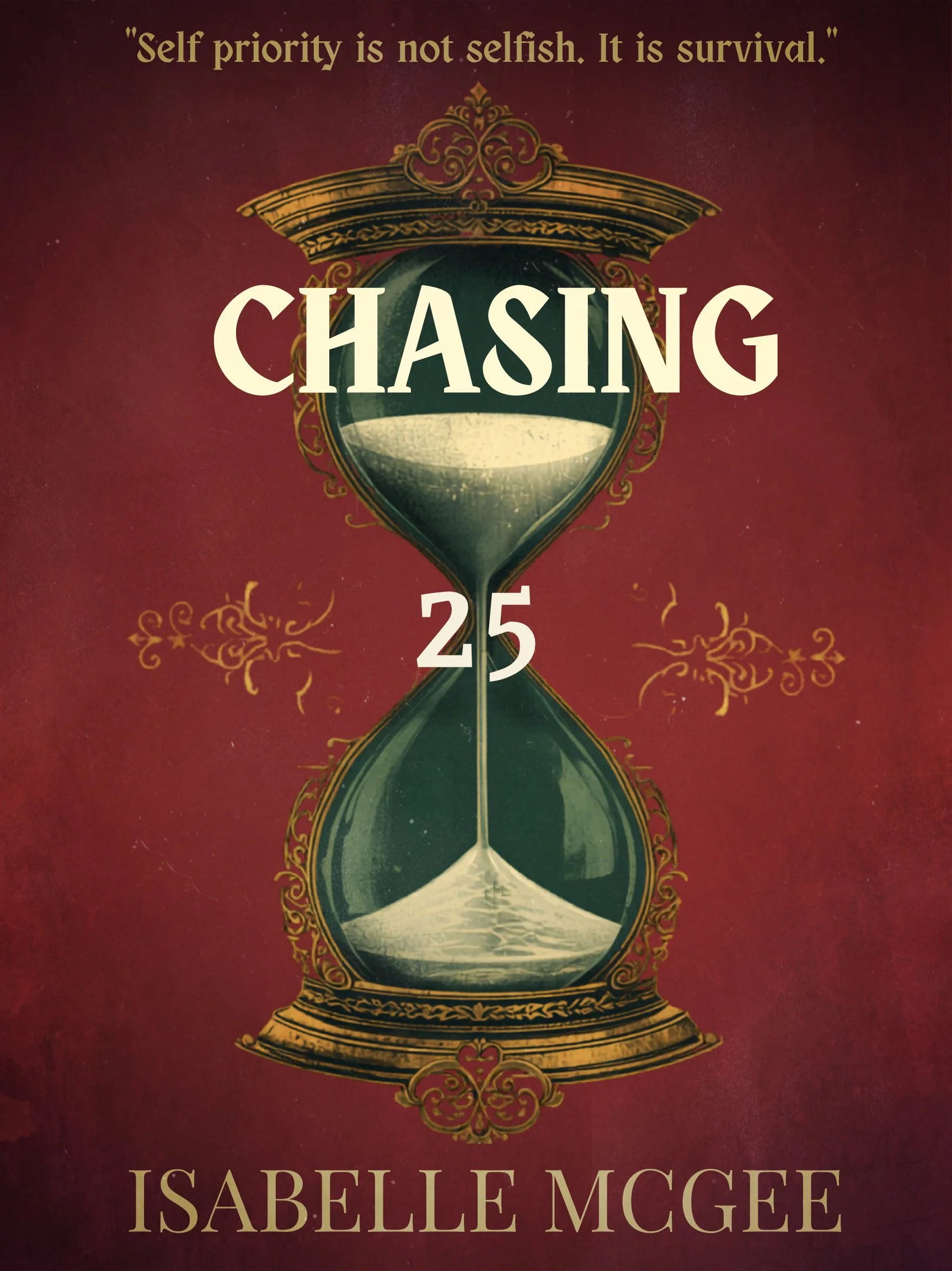
Surprise: Chasing 25 Is Already Here
Okay, I have to tell you something, and I've been sitting on it for a few hours because I honestly could not stop smiling long enough to type it out.
Chasing 25 was supposed to launch on July 20th. That was the plan. That was the date on the calendar, the date I told you, the date the Facebook event still says.
It went live seven days early instead.
I did not see that coming, and I could not hold onto the secret for even one more day. So here we are. Surprise! The book is out. It's real. It's sitting on Amazon right now, in paperback and Kindle, ready for anyone who wants it.
Some lessons you only learn by surviving them.
I did not write this book because I had it all figured out. I wrote it because I did not, and I spent a long time feeling completely alone in that. The hard seasons, the grief, the self-doubt, the moments where you are doing everything right and life still falls apart anyway.
Chasing 25 is 25 things I had to learn the hard way. About self-priority, about letting go, about showing up for yourself when nobody else is going to. About choosing your life on purpose instead of just surviving it.
This is not a book about being young. It is a book about being human. About the part of the journey nobody talks about honestly enough.
If you have ever felt like you were white-knuckling your way through life and wondering when it gets better, this is for you.
It gets better. But first you have to choose it
If you've been following along through Round 2 edits, spine width chaos, cover reveals, and me talking way too much about hourglasses, thank you. Genuinely. You watched this thing get built from the inside out, and now it's yours to actually hold.
So here's what I'm asking: go get your copy. Read it whenever it finds you at the right moment, there's no rush. And when you're done, if it gave you even a little bit of what I hoped it would, leave a review. It means more than you know for a first-time author trying to get this book in front of people who need it.
I'll still be celebrating properly on July 20th, like planned. But for now? The wait is over.
Go get your copy. And thank you for being here for this.
With love and a whole lot of bayou in my bones,
Isabelle
Get your copy here: https://a.co/d/0fe2TaQy
My Writing Process Does Not Exist and That Is Okay
A lot of authors out there have a writing process. Artists have a painting process. Creatives of all kinds seem to have these carefully structured routines with blocked off hours and dedicated creative windows and systems that keep everything moving forward on schedule.
If you came here looking for that from me I am sorry but I genuinely cannot help you there.
My full time author schedule is relatively nonexistent and I have made peace with that.
Here is what my day actually looks like. I wake up -- whenever that is, and it could genuinely be any time -- make my coffee, sit down at my desk, check my emails, and respond to what needs a response. After that everything is chaos. Beautiful, productive, completely unscheduled chaos.
I do not wake up at a certain time. I do not go to bed at a certain time. Some nights I am asleep by 10pm and up early ready to tackle the world. Other nights, because I spent years working night shifts and have always been a night owl at heart, I am going to bed at 6am and waking up at 3pm. And honestly it is what it is.
I have tried blocking out my schedule almost hour by hour. Breaks at specific times, creative work in specific windows, the whole system. It does not work for me and I think I finally understand why.
I cannot sit down and feel forced to be creative. I will be creative when I want to be creative. That is just the truth of how I work and I stopped fighting it.
Editing is the exception. Editing I force myself to do because if I do not create a deadline for myself I simply will not do it. There is no natural creative pull toward editing for me. It is all discipline and mild dread and self imposed consequences. But everything else -- the writing, the content creation, the building -- that happens when it happens.
My day looks like working for an hour or two and then going to hang out with my fiance. Then getting back to it when he is busy with his hobbies. Then working again late into the night because something clicked and I cannot stop. I probably work more than eight hours most days but the majority of the time it does not feel like work because I am doing something I actually love.
That is the thing nobody tells you about pursuing your dream full time. When the passion is real it does not feel like a job even when it is technically labor. Even when it is unpaid labor for stretches that would make a reasonable person quit. You just keep going because stopping does not feel like an option.
So no. I do not have a process.
I have a dream. I have a passion. I have coffee and a desk and a fiance who puts up with me disappearing into my work at completely unpredictable hours. And somehow, in the middle of all that beautiful chaos, things get made.
That is enough for me. 🖤
Bayou Bound Books Isn't Just a Book Brand. It's a Creative World.
Quick answer: Bayou Bound Books is the creative brand of Southern Gothic horror author Isabelle McGee (soon to be Isabelle Herrscher). It started with books, including Prompt To Grow, Get Out of the Swamp, and the upcoming Chasing 25, and has grown to include a monthly short story series (the Bayou Archive), branded merch, and original art prints. The books are still the core of everything. Everything else is an extension of the same creative world, not a separate business.
Why Bayou Bound Books Is More Than Just Books
I've spent the last several months building Bayou Bound Books as a full-time author brand, Southern Gothic horror, bayou atmosphere, Louisiana roots. That's not changing. Writing is still the center of everything I do, and it always will be.
But being a full-time author doesn't mean I'm only ever making one thing. I'm also a full-time creative, and that means the same world I write in shows up in more than just pages sometimes.
That's why Bayou Bound Books now includes:
Books: Southern Gothic horror and personal narrative, including Prompt To Grow, Get Out of the Swamp, and Chasing 25 (releasing July 2026)
The Bayou Archive: a monthly short story for readers who want a piece of this world every month
Merch: wearable pieces of the Bayou Bound Books world, fulfilled through Printful
Art prints: original creative pieces, now available as printed art, born from the same voice and atmosphere as the books
Are the Art Prints a New Direction for Bayou Bound Books?
No. The art prints aren't a pivot away from being an author. They're proof that the "author" part was never the whole picture. Bayou Bound Books has always been about building a full creative world rooted in Southern Gothic and bayou storytelling. The books are the foundation. The art is another room in the same house. You can shop them here: https://www.bayouboundbooks.com/shop/art
What's Next for Bayou Bound Books
The focus stays on the books first. Chasing 25 is releasing July 2026, with more Southern Gothic horror titles in progress after that. Everything else, the Archive, the merch, the art, exists to bring readers deeper into the same world, not to replace what got them here in the first place.
Editing Chasing 25: The Part Nobody Talks About
Starting the editing process feels a lot like being back in school and realizing the homework never actually ends.
I chose this. I love this. Writing and creating and building stories is the thing I would pick every single time if you gave me the choice again. But editing? Editing is the part I would skip if I could. It is the necessary evil of the whole process and I say that with full awareness that it is also one of the most important parts.
I picked the editing back up last week for Chasing 25 and I would be lying if I said I was not walking into it with a knot in my stomach.
Here is the thing about editing that nobody really prepares you for. No matter how many times you go through your own manuscript you are going to miss things. I know this because I lived it with Prompt To Grow. I went back after it was already published and found embarrassing mistakes on almost every page of the first edition. Some I went back and fixed. Some I did not. And as much as that stings, I have made peace with it.
You know when I notice the errors I missed? Once the book is already published and already in someone's hands. Every single time. Without fail.
That is not a failure. That is just being human. And honestly it is also proof that the work is real, that it came from a real person doing their best with what they had at the time. You can watch my work evolve if you go back far enough. The mistakes are part of that evolution. They show where I was when I made them.
But it does not make the editing process any less anxiety inducing.
There is something specific about editing Chasing 25 that makes it harder than editing a journal. This book is personal in a way that my previous work was not. Every chapter I go back through I am not just looking for errors. I am sitting inside moments from my own life and deciding how much of the truth to leave on the page. That is a different kind of work. It requires a different kind of nerve.
I am genuinely excited to get this book into the world. July 20th feels real and close and terrifying in the best possible way. But between now and then there is a manuscript that needs me to sit with it, page by page, and do the uncomfortable work of making it the best version of itself I am capable of producing on my own.
No professional editor. No team. Just me, the manuscript, and a lot of coffee.
That is indie publishing in its most honest form.
And I would not trade it for anything -- even on the days it feels like homework. 🖤
Book Launch date July 20, 2026